Welcome to the SCARF website

This year, 2009, SCARF celebrates its Silver Jubilee. For an NGO with modest beginnings in 1984 - three part-time staff, and a small office - this silver jubilee is a cherished milestone. Over the years, we at SCARF have faced several challenges, beginning with the word "schizophrenia" itself, which most people found difficult to pronounce and understand. Additionally, donors were reluctant to be associated with mental disorders; and unlike with other disabilities, there was little or no empathy for the mentally ill. Schizophrenia itself was considered incurable - so why invest time and money?

Over two and a half decades, the SCARF team including the Board of Management and staff has strived to address these and other concerns. Our objective has been to convince the community that schizophrenia, one of the greatest disablers of youth, requires sustained professional commitment and pubic support. Slowly and steadily, SCARF has grown to be a referral centre for the treatment and rehabilitation of persons with chronic schizophrenia from around and outside India. SCARF now offers a wide spectrum of interventions in varied settings including out-patient, day care, community and in-patient residential centers.

We haven't neglected research. A number of very prestigious national and international collaborations, over 150 papers published in peer reviewed journals and the huge success of the three editions of ICONS are testimony to SCARF's research track record. SCARF is one of few centers in South Asia to be named as a Collaborating Centre of the World Health Organization for Mental Health Research and Training. Students from mental health and allied disciplines are trained regularly at SCARF.

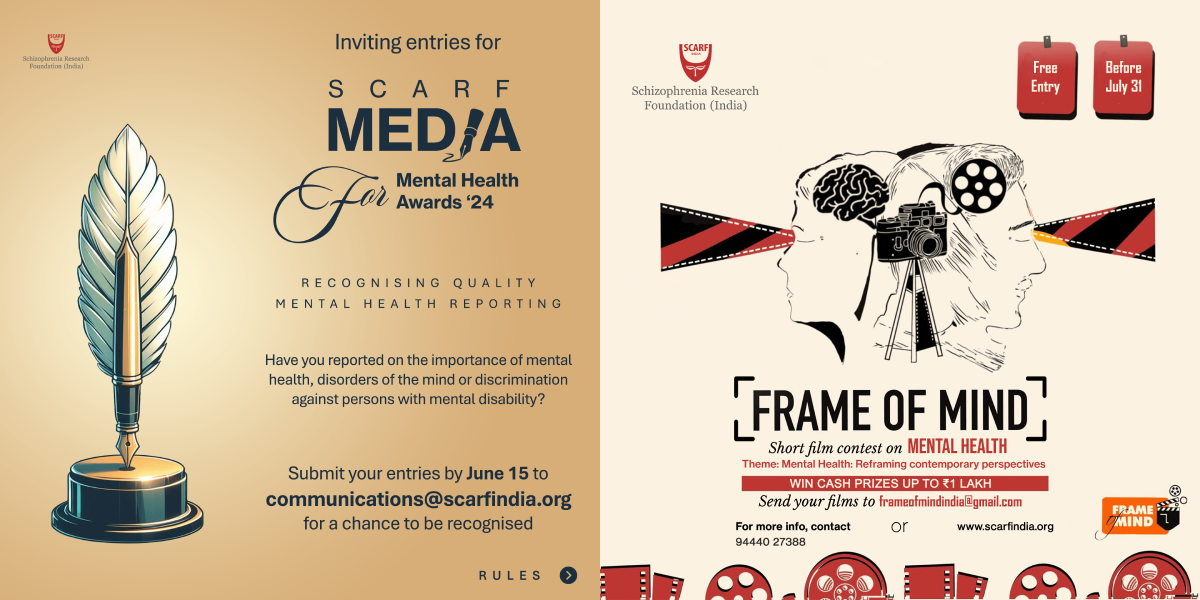
SCARF also took upon itself the task of improving awareness about schizophrenia and mental illnesses among various groups of people including doctors, teachers, community level workers, media, and the general public. Frame of Mind, a unique film festival on mental health is one of SCARF's innovative strategies in this direction

Teaching, training, community based rehabilitation, lobbying and supporting children of the mentally ill have been some of our other activities.

As we enter the next quarter century, we look forward to a phase of consolidation and innovation, to exploring new approaches to care and rehabilitation and to continued support from our growing family of well-wishers.